

The Backbone of Modern Infrastructure: A Comprehensive Analysis of Hot Mix Asphalt Paving
The modern world moves on wheels, and beneath those wheels lies a complex, engineered foundation that is often taken for granted. Among the various materials used to pave the arteries of civilization, Hot Mix Asphalt paving (HMA) stands as the preeminent choice for high-traffic roadways, airports, and industrial pavements. It is a sophisticated composite material, a marriage of geology and chemistry, designed to withstand the relentless forces of traffic loading and environmental weathering. Understanding Hot Mix Asphalt paving requires a deep dive not just into the act of laying asphalt, but into the science of its composition, the precision of its production, and the artistry of its placement.
At its core, Hot Mix Asphalt paving is a precisely engineered mixture of two primary components: aggregates and asphalt binder. The aggregates, which typically constitute about 95% of the mixture by weight, provide the structural skeleton. These are not merely random stones; they are carefully selected, crushed, and screened rocks that must possess specific physical properties. High resistance to abrasion, durability, and angularity are crucial. Angular aggregates interlock to form a strong, stable framework that distributes loads effectively, preventing the pavement from rutting or deforming under heavy trucks. The gradation, or the distribution of particle sizes, is mathematically calculated to achieve maximum density. A well-graded mix ensures that smaller particles fill the voids between larger ones, creating a dense, impermeable structure that resists water infiltration—a primary cause of pavement failure.
Binding this rocky skeleton together is the asphalt binder, a viscoelastic petroleum product that makes up the remaining 5% of the mix. While it is a minor component by weight, its role is disproportionately critical. The binder acts as the glue, coating the aggregates and holding them together. More importantly, it provides the pavement with flexibility. Unlike rigid concrete, asphalt must be able to bend slightly under traffic loads and expand and contract with temperature fluctuations without cracking. The performance grade of the binder is selected based on the specific climate of the project location, ensuring it remains stable in the blistering heat of summer and flexible in the freezing grip of winter.
The production of Hot Mix Asphalt paving is a high-temperature industrial process that takes place in an asphalt plant. The term “hot mix” is literal and essential; the mixture must be heated to temperatures typically ranging between 150°C and 190°C (300°F to 375°F). This heat serves two vital functions: it removes moisture from the aggregates, ensuring a strong bond, and it reduces the viscosity of the asphalt binder, allowing it to flow and coat the stone surfaces uniformly. The production process is a continuous cycle of drying, heating, and mixing. Cold feed bins dispense the aggregates onto a conveyor belt, which feeds them into a rotating dryer drum. Here, they are tumbled through a flame to remove moisture and heat them to the required temperature. The hot aggregates are then screened and stored in hot bins before being weighed and introduced into the pugmill mixer, where the heated asphalt binder is injected. The result is a homogeneous, black, viscous material ready for transport.
Transportation is the next critical link in the chain. Dump trucks must be clean and often require a thin film of release agent to prevent the sticky asphalt from adhering to the bed. However, the logistics of delivery are governed by thermodynamics. The mixture begins to lose heat the moment it leaves the mixer. Since the compaction of HMA is heavily dependent on temperature, the mix must be delivered to the paver while it is still within a specific “workability” window. If the asphalt cools too much before it is laid, it becomes unworkable and cannot be compacted to the required density, leading to premature pavement failure.
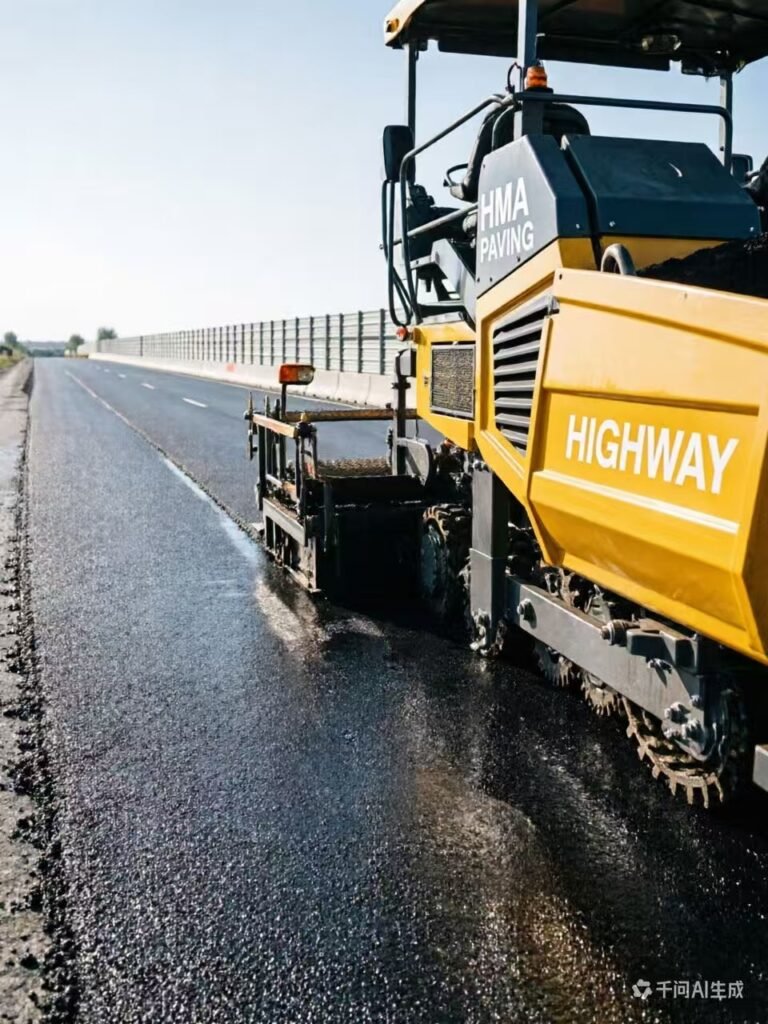
The paving operation itself is a synchronized dance of heavy machinery. The paver is a sophisticated piece of equipment that receives the mix from the trucks, spreads it across the road surface, and provides an initial compaction. The paver’s screed—the heavy metal plate at the rear—vibrates and heats the mat of asphalt, leveling it to the precise grade and slope designed by engineers. The operator must maintain a constant speed and a consistent head of material in front of the screed to ensure a smooth, uniform surface. Any variation in speed or material flow can result in surface irregularities, such as bumps or tears, which affect ride quality.
Following closely behind the paver is the compaction train, typically consisting of a breakdown roller, an intermediate roller, and a finish roller. Compaction is arguably the most critical phase of construction. The goal is to reduce the air voids in the mixture to a target level, usually between 3% and 5%. If the air voids are too high, the pavement will be permeable to water and air, leading to oxidation of the binder and moisture damage. If the voids are too low, the pavement may become unstable and bleed asphalt to the surface, creating a slick, dangerous driving condition. The breakdown roller, usually a heavy steel-wheel vibratory roller, achieves the majority of the density reduction while the mix is hottest. The intermediate roller further densifies the mat, and the finish roller removes any roller marks to provide a smooth texture.
Quality control in Hot Mix Asphalt paving is rigorous and continuous. It begins at the plant with the testing of raw materials and continues through the production process. Technicians constantly sample the mix to verify the asphalt content, aggregate gradation, and temperature. Once the asphalt is laid, field technicians perform density tests using nuclear gauges or non-nuclear devices to ensure the compaction meets specifications. Core samples are often extracted from the finished pavement to verify thickness and density in the laboratory. This data-driven approach ensures that the pavement not only meets the design specifications but will also perform reliably for its intended design life, typically 20 years or more.
Despite its dominance, the HMA industry faces challenges and evolves with technology. Environmental concerns regarding the energy consumption of heating aggregates and the emissions from asphalt plants have led to the development of Warm Mix Asphalt (WMA) technologies, which allow production at lower temperatures. Furthermore, the push for sustainability has increased the use of Recycled Asphalt Pavement (RAP), where old asphalt is milled, crushed, and reintroduced into new mixes. However, traditional Hot Mix Asphalt paving remains the gold standard for high-performance pavements due to its proven track record, structural capacity, and ease of maintenance.
In conclusion, hot mix asphalt paving is far more than a simple construction activity; it is a complex engineering discipline. It transforms raw geological materials and refined petroleum products into a high-performance composite capable of supporting the immense demands of modern transportation. From the microscopic bond between the binder and the aggregate to the macroscopic smoothness of a finished highway, every aspect of Hot Mix Asphalt paving is governed by science and precision. As infrastructure demands grow, the continued refinement of Hot Mix Asphalt paving technology ensures that the roads we travel on remain safe, durable, and efficient.