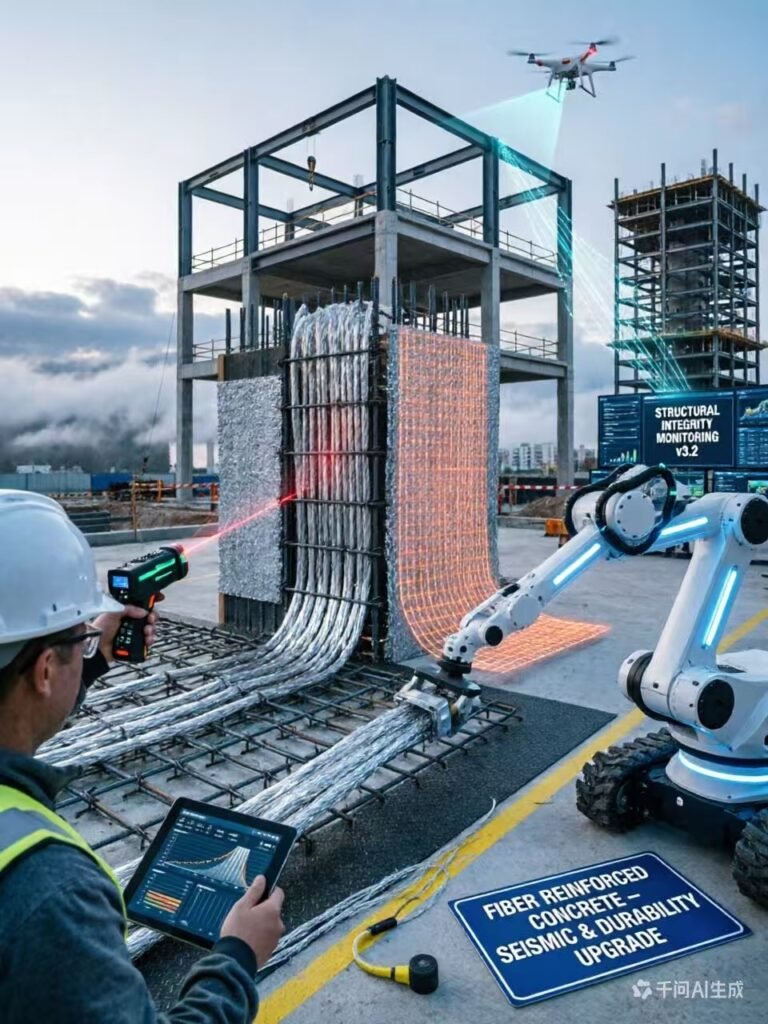


Revolutionizing Construction: The Multifaceted Advantages of Fiber Reinforcement for Concrete
Concrete has long been the backbone of modern civilization, the literal foundation upon which our cities stand. Yet, for all its compressive strength, traditional concrete possesses an inherent Achilles’ heel: brittleness. It cracks under tension, succumbs to environmental stress, and requires massive amounts of steel reinforcement to function effectively in structural applications. Enter the game-changer: fiber reinforcement for concrete. This technology, which involves the dispersion of short, discrete fibers throughout the concrete matrix, is not merely an additive; it is a fundamental transformation of the material’s DNA, turning a brittle stone-like substance into a ductile, resilient, and highly durable composite.
The primary mechanism of fiber reinforcement for concrete is best understood at the microscopic level. Traditional concrete fails because micro-cracks, inevitable during the curing process or under load, propagate rapidly until structural failure occurs. Fibers act as a three-dimensional support system, bridging these micro-cracks and arresting their growth. Whether using steel, glass, synthetic polymers like polypropylene, or natural fibers, the principle remains the same: the fibers distribute stress uniformly throughout the volume of the material. This “bridging” effect prevents the sudden, catastrophic failure typical of plain concrete, replacing it with a more gradual, predictable deformation. This shift from brittle to pseudo-ductile behavior is the cornerstone of why fiber-reinforced concrete (FRC) is becoming the material of choice for critical infrastructure.
One of the most immediate and visible benefits of incorporating fibers is the drastic reduction in cracking. Plastic shrinkage cracking, which occurs when the surface of fresh concrete dries faster than the underlying layers, is a common aesthetic and durability issue. Synthetic fibers, particularly polypropylene, are exceptionally effective here. They create a network that holds the mix together, reducing bleed water and stabilizing the aggregate. This results in a surface that is not only smoother and more aesthetically pleasing but also significantly more durable. By minimizing the entry points for water and corrosive agents, the service life of the structure is extended. In environments subject to freeze-thaw cycles, this is critical; the fibers absorb the internal pressure of expanding ice, reducing spalling and surface degradation by up to 60% compared to conventional mixes.
Beyond durability, fiber reinforcement for concrete offers profound structural advantages, particularly regarding toughness and impact resistance. In applications like industrial flooring, tunnels, and pavements, the ability to absorb energy is paramount. Steel fibers, with their high tensile strength, transform the post-cracking behavior of the slab. Even after the concrete matrix has cracked, the steel fibers continue to carry the load, allowing the structure to sustain heavy traffic and impact loads that would shatter unreinforced concrete. This “residual strength” allows engineers to design thinner sections or reduce the amount of traditional rebar, leading to lighter, more efficient structures. For instance, in seismic zones, the energy dissipation capabilities of fiber-reinforced elements allow buildings to sway and deform during an earthquake without collapsing, saving lives and reducing repair costs.
The construction process itself is also revolutionized by this technology. The placement of traditional steel reinforcement cages is labor-intensive, time-consuming, and prone to error. Fibers, being mixed directly into the batch, eliminate the need for complex bar bending and tying in many applications. This simplification accelerates construction schedules significantly—sometimes by as much as 20%—and reduces labor costs. Furthermore, in complex architectural shapes or shotcrete applications (such as tunnel linings), fibers provide internal cohesion that prevents the material from slumping or falling off vertical surfaces. This versatility allows architects and engineers to push the boundaries of design, creating thin-shell structures and intricate facades that would be impossible with standard reinforcement.
Sustainability is another compelling driver for the adoption of fiber reinforcement for concrete. By enhancing the material’s performance, less concrete is often required to achieve the same structural goals, directly reducing the carbon footprint associated with cement production. Additionally, the extended lifespan of fiber-reinforced structures means fewer repairs and replacements over time. Innovations are even bringing natural fibers—such as bamboo, hemp, or sisal—into the mix, offering renewable, low-carbon alternatives for non-structural applications.
In conclusion, fiber reinforcement for concrete represents a paradigm shift in construction materials. It solves the age-old problem of concrete’s brittleness, offering a solution that is tougher, more durable, and easier to work with. From the microscopic bridging of cracks to the macroscopic resilience of earthquake-proof buildings, fibers are proving that the future of construction lies not just in making things bigger, but in making them smarter and more resilient. As we face the challenges of aging infrastructure and climate change, this technology stands as a testament to the power of material science in building a safer, more sustainable world.