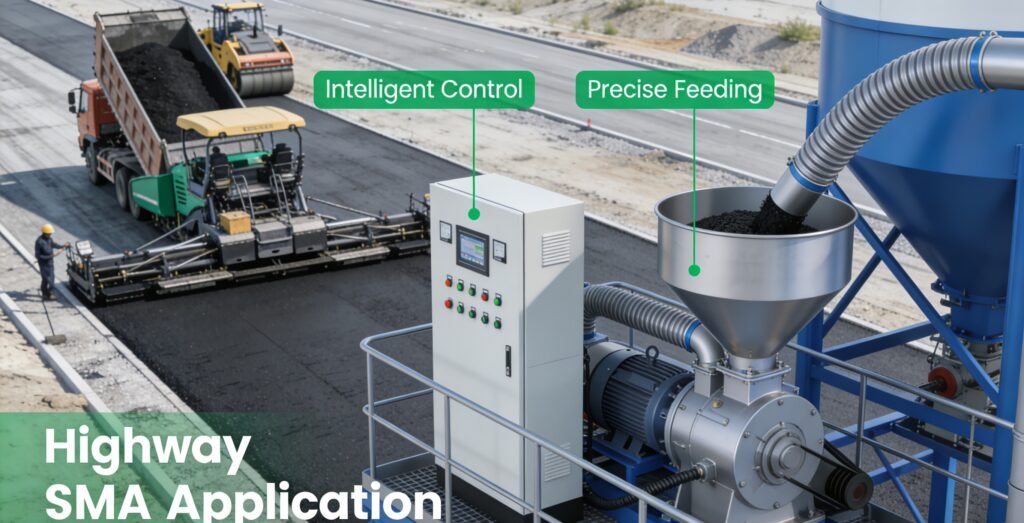


Wood cellulose fiber feeder machines, as specialized automated equipment for accurately adding wood cellulose fibers into asphalt mixtures, have become indispensable supporting machinery in modern road engineering. With the global promotion of high-performance, long-life, and eco-friendly pavement technologies, the demand for wood cellulose fiber feeders in highway, urban road, bridge deck pavement, and airport runway projects continues to rise. This article analyzes the application value, market drivers, technical evolution, and long-term development prospects of wood cellulose fiber feeders for road use, demonstrating their vital role in the upgrading of road construction equipment and the sustainable development of transportation infrastructure.
Wood cellulose fiber is a key modifier for stone matrix asphalt (SMA) and high-modulus asphalt mixtures. It acts as a stabilizer, adsorbent, and reinforcing agent in asphalt mixtures, effectively improving the rutting resistance, crack resistance, water damage resistance, and durability of pavements. In the past, manual feeding was widely adopted in road construction, which not only had high labor intensity and harsh operating environments but also suffered from uneven dispersion, inaccurate dosage, missed feeding, and delayed feeding, seriously affecting the quality stability of asphalt mixtures. Wood cellulose fiber feeders realize automatic weighing, quantitative feeding, timed delivery, and uniform dispersion through electromechanical integration control systems, perfectly matching the production rhythm of asphalt mixing plants. They eliminate human errors, improve mixing uniformity, and ensure the mechanical properties and service performance of pavement materials, which is a core equipment to realize standardized and refined construction of high-grade roads.
The market demand for wood cellulose fiber feeder machines are driven by multiple factors. First, the global expansion of transportation infrastructure construction provides a solid foundation for market growth. In China, the continuous construction of expressways, national and provincial trunk roads, urban expressways, and rapid transit systems has led to a sharp increase in the application of SMA asphalt mixtures, directly driving the demand for supporting fiber feeding equipment. In Europe, North America, and Southeast Asia, the renewal of old roads and the construction of new infrastructure also require high-performance modified asphalt technologies, bringing stable incremental space for wood cellulose fiber feeders. Second, the upgrading of road quality standards and construction specifications has accelerated the replacement of manual feeding by automated equipment. More and more national and industrial standards clearly require the use of special metering and feeding equipment for fiber additives, which has consolidated the market position of wood cellulose fiber feeders. Third, the concept of green and low-carbon construction has become popular, and wood cellulose, as a renewable biomass material, is widely recognized in the road industry. The coordinated development of environmentally friendly fibers and automated feeding equipment has formed a positive industrial cycle.
In terms of technological progress, wood cellulose fiber feeder machines are evolving towards intelligence, precision, energy saving, and high compatibility. Early products mainly focused on basic metering and feeding functions, while modern equipment is equipped with dual control systems of weighing and timing, high-precision sensors, PLC programmable control, and human-computer interaction interfaces. Some high-end models realize remote monitoring, fault self-diagnosis, data storage, and output functions, which can be seamlessly connected with intelligent asphalt mixing stations to meet the needs of digital construction and quality traceability. At the same time, the optimization of feeding mechanisms, such as anti-bridging hoppers, forced dispersion devices, and variable-frequency conveying systems, effectively solves the problems of fiber agglomeration and blockage, and adapts to different types of wood cellulose, polyester fiber, anti-rutting agent, and other additives. The modular and lightweight design makes the equipment easier to install, transfer, and maintain, suitable for fixed mixing stations and mobile construction scenarios.
The development prospects of wood cellulose fiber feeder machines are broad, but they also face certain challenges. On the one hand, the industry needs to further improve product standardization and serialization. At present, there are differences in configuration, performance, and interface standards among equipment from different manufacturers, which brings inconvenience to user selection and system matching. Promoting the formulation of unified industry standards and improving the versatility and interchangeability of components will help optimize the industrial ecological environment. On the other hand, the cost performance of equipment and the level of after-sales service need to be enhanced. For small and medium-sized construction enterprises, the investment cost of intelligent feeding equipment is relatively high, and it is necessary to launch cost-effective models for different user groups through technological iteration and scale production. In addition, the professional training of operators and the timeliness of after-sales maintenance are also important factors affecting the application effect of equipment.
Looking forward, the wood cellulose fiber feeder machines industry will usher in three major development trends. First, deep integration with intelligent construction. With the application of big data, Internet of Things, and artificial intelligence in road engineering, wood cellulose fiber feeders will develop towards autonomous decision-making, adaptive adjustment, and full life cycle management. The equipment can automatically optimize feeding parameters according to mixture ratio, temperature, humidity, and construction speed, and realize real-time interaction with mixing stations, pavers, and rollers to build an intelligent construction system. Second, green and energy-saving upgrading. The equipment will adopt high-efficiency motors, low-noise components, and dust recovery devices to reduce energy consumption and environmental impact in the working process, in line with the national dual-carbon target and green construction requirements. Third, market expansion and industrial chain extension. Manufacturers will not only provide single feeding equipment but also launch integrated solutions including fiber selection, ratio design, equipment matching, and technical services, transforming from product suppliers to system service providers, and enhancing added value and core competitiveness.
In the global context of infrastructure renewal and technological innovation, wood cellulose fiber feeder machines, as important equipment to improve road quality and construction efficiency, have irreplaceable application value and huge market potential. With the continuous advancement of road construction technology, the enhancement of environmental protection requirements, and the iterative upgrading of intelligent equipment, the wood cellulose fiber feeder industry will move towards a more standardized, intelligent, and green direction. For equipment manufacturers, increasing R&D investment, optimizing product performance, and improving service systems are the keys to seizing market opportunities; for the road construction industry, the popularization and application of advanced wood cellulose fiber feeders will help build safer, more durable, and more environmentally friendly transportation infrastructure, and promote the high-quality development of the road industry.
In the future, with the acceleration of global infrastructure interconnection and the in-depth implementation of sustainable development strategies, wood cellulose fiber feeders will play a greater role in more road projects. They will become an important part of the modern road construction equipment system, contributing to the construction of efficient, safe, green, and intelligent transportation networks around the world.